
Four Posts, Four Shapes, No Following Required
lightbulb The big idea
LinkedIn ranks the feed for relevance, not popularity, and one input is explicit: whether a post comes from your immediate network or from someone you've never connected with1.
A post only reaches your 2nd- and 3rd-degree connections if someone in your 1st-degree network likes, comments on, or reshares it first2. Every comment you leave on someone else's post is a distribution move, not a courtesy.
None of this takes volume. A 2022 study of 20 million LinkedIn users, published in Science, found that moderate ties, not your ten closest contacts, not total strangers, were the most effective at moving people into new jobs3. The effect was strongest in more digital industries.
That's the opposite of what a lot of career advice assumes: you don't need a following, and you don't need your best friends to reshare you. You need a wide layer of people who barely know you to see enough of your activity to remember you exist. Four posts a month, in four repeatable shapes, plus daily comments, is enough to build that layer.
That "four a month" number is this playbook's own recommendation, not a figure LinkedIn or any study has proven optimal. Treat it as a floor you can hold for months, not a law.
The First Line Decides Everything
Weak: "I am incredibly grateful and humbled to share that after an intense 6-month search, I have accepted an amazing new opportunity as a Senior Analyst, and I couldn't have done it without my incredible network!!!"
Strong: "Six months. 140 applications. One offer. Here's the one thing I'd do differently."
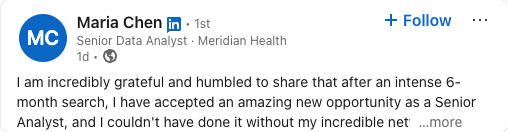
Fold hits after four words of thanks.
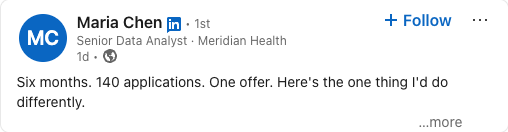
Three numbers before the fold. Then a promise.
LinkedIn cuts a post off after roughly the first few lines and drops in a "…see more" link. AuthoredUp, a LinkedIn-focused content tool, reported in 2026 that the cutoff lands around 210 characters on desktop and around 140 on mobile. LinkedIn itself has never published an exact number, and the point shifts by device4.
The weak version spends its entire allotment on gratitude. A recruiter scrolling past sees adjectives, not information, and keeps scrolling. The strong version front-loads the one thing that survives the fold: a number. Everything after the fold is optional. Everything before it is the whole pitch.
Renee Okafor is a composite, drawn from real search stories, not a data point. She is an HR business partner laid off in a March 2026 reorg. She picked two pillars from the grid below: Field Insight (a hiring fix she knew worked) and Personal Story (what the search itself felt like).
She wrote four posts that first month, one per shape. An Insight post on a screening mistake she used to make. A Story post on the week she got laid off. A List post on three interview questions she'd started asking differently. A Question post asking her network how they'd handled a counteroffer.
She commented daily on posts from other HR people already in her feed, three comments, two minutes each. She didn't track likes. She tracked profile views and watched the number climb steadily through the month, not because any single post went viral, but because she showed up in the same feeds, in the same niche, week after week.
Not every post lands. My own worst-performing post was a line I was proud of for about six hours: "Comment YES if you're also job hunting right now." It pulled forty comments and did nothing for my profile views. I'd mistaken noise for reach.
LinkedIn's own feed team says explicitly that posts built around forced comments are now pushed down the feed on purpose, because "Comment YES if you agree" is exactly the engagement bait the platform is built to detect and demote5. The comments were real. The distribution wasn't.
The habit is one shape, one hook, once a week.
Every step below assumes you already have the tab open. Nothing here needs an inspiration.

Five Steps to a Habit You Can Keep
1. Pick two pillars from the grid. Draw a 2×2: Insight vs. Story on one axis, Field vs. Personal on the other.
| Insight | Story | |
|---|---|---|
| Field | A fix you know works | A moment from the work itself |
| Personal | A lesson from the search | What the search feels like |
Pick two quadrants, not four. Four pillars means you're staring at a blank page trying to remember which lane you're supposed to be in this week. Two means you always have somewhere to start.
2. Learn the four post shapes. Insight, Story, List, Question, in the template below. Every post you write for the rest of your search is one of these four. Stop treating each post like a blank page.
3. Schedule one post a week. Pick a day and a fifteen-minute slot. Write the post the shape on the calendar dictates, not whatever you feel like that morning. A rotating four-week cycle means you never face a blank page in the same shape twice.
4. Comment on three posts a day, two minutes each. Justin Welsh, who built a public LinkedIn following into a business, sets his own standard this way: "You have to make your comments so valuable that they could be a standalone post all by themselves"6.
Not "Great post!" Three comments like that a day, on people inside your own field, take about six minutes total, and each one puts your name in front of that poster's own network2.
Post vs. comment vs. DM, when in doubt:
| Move | Use it when |
|---|---|
| Post | You have one specific insight, story, list, or question your two pillars cover, once a week. |
| Comment | You can add something a stranger reading the thread would find useful, three a day. |
| DM | A comment thread has already turned into a real back-and-forth, or someone actively offered to help. |
Don't cold-DM strangers as a substitute for showing up in public first. A DM to someone who has never seen your name is a cold email with worse formatting.
5. Track one metric: profile views. Ignore likes. A like doesn't tell you whether anyone in a hiring position looked you up; a profile view is the closest signal you have to that.
No study proves that posting weekly causes profile views to rise by a set amount. Treat the number as a check on whether you're doing the work, not as a guaranteed return. Check it once a week, on the same day you write your post, and move on.
The Four Shapes, Ready to Fill In
Copy the row that matches what you actually have to say this week.
| Shape | Scaffold | Example |
|---|---|---|
| Insight | [Common belief] is wrong. Here's [what's actually true] and [what to do instead]. | "Most resumes get rejected for formatting, not content. Here's the one-column layout that survives an ATS parse." |
| Story | [Situation] → [complication] → [what changed]. | "I had the offer verbally, then the req got frozen. Here's what I did in the two weeks after." |
| List | [Number] [things] most people get wrong about [topic]. | "3 lines I cut from my About section, and what replaced them." |
| Question | I ran into [specific scenario] this week. How do you handle [the same thing]? | "A recruiter asked for my salary history before the first call. How do you usually handle that?" |
| First line | |
|---|---|
| Weak | "I am incredibly grateful and humbled to share…" |
| Strong | "Six months. 140 applications. One offer." |
Six Checks Before You Post
-
Names one pillar(Field Insight, Field Story, Personal Insight, or Personal Story), not "just sharing something."
-
First line survives the fold on its own.No "I'm excited to announce" filler ahead of the actual point.
-
Uses one of the four shapes on purpose,not by accident.
-
Contains no engagement-bait line("Comment YES if…", "Tag someone who…").
-
You've commented on three other people's posts today,not just published your own.
-
You checked profile views this week,and nothing else.
Your posts and comments keep you visible while you search. None of it matters if the resume behind your profile can't get past the software that reads it first. That's Chapter 4.
Notes
-
LinkedIn (official company post), Tim Jurka, "Updates to the LinkedIn Feed: Focusing on Authentic, Relevant Conversations," March 12, 2026. Confirms the feed ranks for relevance, including connection distance, rather than raw popularity. https://www.linkedin.com/pulse/updates-linkedin-feed-focusing-authentic-relevant-tim-jurka-umwnc ↑↑
-
LinkedIn Help Center, "Visibility of Shared Posts," accessed 2026-08-14. Confirms a post reaches 2nd-/3rd-degree connections only if reshared, commented on, or liked by a 1st-degree connection. https://www.linkedin.com/help/linkedin/answer/a523141 ↑↑
-
Karthik Rajkumar, Guillaume Saint-Jacques, Iavor Bojinov, Erik Brynjolfsson, Sinan Aral, "A Causal Test of the Strength of Weak Ties," Science, published Sept 15, 2022. Study of ~20 million LinkedIn users; confirmed via the freely accessible MIT News summary (the Science DOI page is paywalled). https://news.mit.edu/2022/weak-ties-linkedin-employment-0915 ↑
-
AuthoredUp, Ivana Todorović, "LinkedIn Character Limits 2026," published April 2, 2026, updated Aug 11, 2026. Reports the feed's "…see more" truncation at roughly 210 characters on desktop and 140 on mobile; LinkedIn does not publish an exact figure and the cutoff varies by device. https://authoredup.com/blog/linkedin-character-limit ↑
-
Same source as 1. Confirms LinkedIn is actively de-weighting and demoting engagement-bait posts, naming "Comment YES if you agree" as the type of post targeted. ↑
-
Justin Welsh, "4 Unconventional Tactics to Skyrocket LinkedIn Growth," published July 20, 2024. Verbatim wording of his personal comment standard. https://justinwelsh.me/essays/4-unconventional-tactics-to-skyrocket-linkedin-growth ↑