
The Big Idea: Three Categories, Not One Pile
lightbulb The big idea
Credential requirements aren't uniform across the job market. The U.S. Bureau of Labor Statistics found that only 8.8% of office and administrative support jobs require a license or certification, versus 95.9% of healthcare practitioner and technical jobs (40.4% of all civilian workers, overall)1.
That range is the whole chapter in one number: what a credential does for you depends entirely on the role you're targeting.
Gatekeeper. You cannot legally or practically do the job without it: an RN license, a CPA, a Series 7. If your target role sits near the 95.9% end of that BLS range, this isn't a resume decision. It's a requirement.
Credential-of-the-role. Not legally required, but expected often enough that missing it costs you interviews at your target level. PMP for senior project managers, CFA for asset management, an AWS certification for a cloud-architecture role.
Portfolio-proxy. Doesn't gatekeep and doesn't signal seniority on its own. It proves you can learn a skill and finish something, useful mainly when you have no other evidence that you can do the thing.
Anything that doesn't land cleanly in one of these three is padding. Cut it.
One Certification, Walked Through the Framework
Take Daniel, a mid-career operations manager at a 200-person logistics company. He's run cross-functional projects for six years without ever holding a project-management credential. He's eyeing director-level roles and weighing whether to add the PMP.
Step one: sort it. The PMP isn't a gatekeeper. Nobody needs a license to run a project. It's credential-of-the-role, which means the question isn't "does this help in general," it's "does this help for the specific title I'm targeting."
Step two: check the evidence, with the caveat attached. PMI's own 14th-edition Earning Power survey found U.S. PMP holders reported a $135,000 median salary versus $109,157 for non-holders, a 24% gap. Globally, PMP holders reported a 17% higher median salary than non-holders across 21 countries2.
That's a real signal, but it comes from the organization that sells and administers the PMP exam. It's self-reported salary data from people who chose to get certified, not a controlled comparison against otherwise-identical candidates who didn't.
Step three: weigh it against his specific target, not the average. Daniel pulls ten job postings for the director-level title he wants.
If PMP shows up as "preferred" or "required" in most of them, the credential-of-the-role math holds, and the cost (months of study, an exam fee, prep materials) is worth paying. If it barely appears, he skips it and spends that time on something with more signal for his actual next role.
That's the test for every credential-of-the-role decision: not "is this respected in the field," but "do the postings for my specific next title ask for it."
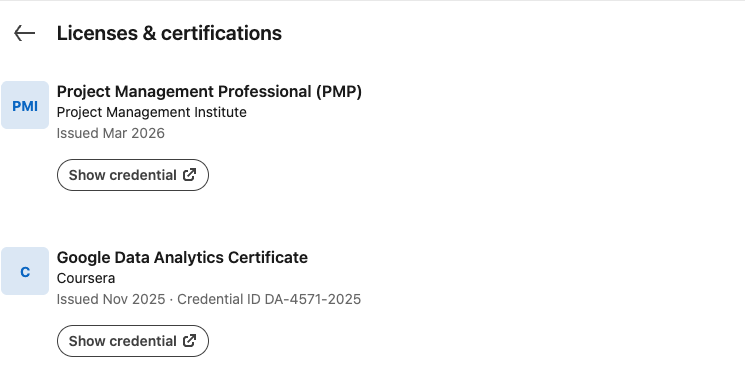
One credential-of-the-role. One portfolio-proxy.
The How-To
1. Sort your certs into the three categories. For each credential on your resume, ask: Do I legally need this to do the job (Gatekeeper)? Is it commonly expected of people already at my target level (Credential-of-the-role)? Or does it only prove I can learn something and finish it (Portfolio-proxy)? Anything left over doesn't have a category. That's your answer.
2. Cut the noise, even the expensive stuff. I paid $1,050 for a two-day Certified ScrumMaster course from Scrum Alliance the year I was job-hunting for product roles. I put the badge on my resume, my headline, my About section. Zero interviews mentioned it across six months of applying.
The roles I wanted asked about shipped products, not Agile ceremonies, and I already had five years of experience running Scrum teams daily. The credential was portfolio-proxy at best, and I didn't need a proxy. If a certification isn't doing real work in one of the three categories, take it off, no matter what it cost.
3. Move survivors above or below Experience based on your role stage. Early-career or switching fields: put Certifications above Experience. You have less work history to lean on, so let the credential carry weight early. Five-plus years of relevant experience: move Certifications below Experience. A recruiter should read your track record first.
4. Give education the same treatment. Relevant coursework, honors, and a capstone project carry signal only if they're recent and specific to your target role. Cut GPA, cut clubs, cut anything more than a few years old, unless it's the degree line itself.
And don't over-read a "degree preferred" posting either way. The Burning Glass Institute studied 11,300 roles and found that when firms publicly dropped degree requirements, actual non-degree hiring rose by only 0.14 percentage points.
That's about 97,000 workers a year out of 77 million annual hires. Only 37% of the firms studied drove real change; 45% changed nothing7. Announcements move faster than hiring behavior. Don't assume either direction from a headline.
5. Handle a schooling gap honestly, one line, no defensiveness. If you didn't finish a degree, say so factually: "Coursework in Mechanical Engineering, Purdue University, 2016 to 2018." No apology, no paragraph explaining why. The reader's eye moves to the next line faster than you'd expect.
The Decision Tree
Picture one root question at the top: Do I need this to legally do the job, or is it standard for people already at my target level? Three yes-branches lead down to "list it," one for each category.
- Gatekeeper ends at "list it as a requirement, near your name."
- Credential-of-the-role ends at "list it, positioned by role stage per Step 3."
- Portfolio-proxy ends at "list it only if you have no stronger proof of the skill."
The single no-branch is blunt: cut it. There's no "keep it just in case" leaf on this tree.
Screenshottable: Signal vs. Cost. A 2×2 grid. Hiring signal (low to high) on the vertical axis, cost in money and time (low to high) on the horizontal.
- High signal, low cost: Google Data Analytics Certificate, $49/month on Coursera, most learners finish around six months, total cost under $3004. Across Google's Career Certificate portfolio (Data Analytics, IT Support, Cybersecurity, Project Management, UX Design), Google's own 2024 graduate survey reports 70%+ of U.S. graduates saw a positive career outcome within six months. That's self-reported by people who finished the program; the survey doesn't disclose a completion denominator3. AWS Certified Solutions Architect – Associate, $150, with AWS recommending about a year of hands-on AWS work first (or the Cloud Practitioner cert as an alternate path)5.
- High signal, high cost: PMP2, CFA, $3,520 to $4,600 across three exam levels, 300+ study hours per level6. Worth it only when your target postings actually ask for it.
- Low signal, low cost: free platform completion badges. Fine to hold. Not worth featuring.
- Low signal, high cost: any certification with real tuition that doesn't map to your specific target role's hiring bar. My CSM lives here.
Five Checks Before You Publish
-
Every certification on your resume is sorted into Gatekeeper, Credential-of-the-role, or Portfolio-proxy.
-
Anything that didn't fit one of the three is deleted.
-
Certifications sit above Experience if you're early-career or switching fields, below it if you have 5+ years of relevant experience.
-
Coursework, honors, and GPA are cut unless recent and directly relevant to your target role.
-
A schooling gap, if you have one, reads as one factual line, no apology.
A clean credentials section gets you read past the first scroll. It won't get you the interview by itself. The fastest path to one is someone inside the company vouching for you. That's Chapter 7.
Notes
-
U.S. Bureau of Labor Statistics, Occupational Requirements Survey, "Credentials" factsheet, 2024 reference year (2025 release), accessed 2026-08-14. Source for the 8.8% (office/admin), 95.9% (healthcare practitioners and technical workers), and 40.4% (all civilian workers) credential-requirement figures. https://www.bls.gov/ors/factsheet/credentials.htm ↑
-
Project Management Institute, "Earning Power: Project Management Salary Survey," Fourteenth Edition, fielded March–April 2025, press release November 13, 2025. Source for the $135,000 vs. $109,157 U.S. median salary figures (24% difference) and the 17% global median-salary premium across 21 countries. https://www.pmi.org/about/press-media/2025/pmp-certification-holders-build-career-momentum-and-experience-earning-advantage-pmi-survey-finds ↑↑
-
Google, "Unlocking opportunity together with the Google Career Certificates," Google Career Certificates Impact Report, published May 29, 2025, underlying data from a 2024 U.S. graduate survey. Source for the "70%+ of U.S. graduates report a positive career outcome within six months" figure. https://blog.google/company-news/outreach-and-initiatives/grow-with-google/google-career-certificates-impact-report-may-2025/ ↑
-
Coursera, Google Data Analytics Professional Certificate program page, accessed 2026-08-14. Source for the $49/month cost, ~6-month typical completion pace, and total cost under $300. https://www.coursera.org/professional-certificates/google-data-analytics ↑
-
Amazon Web Services, "AWS Certified Solutions Architect – Associate" certification page, accessed 2026-08-14. Source for the $150 exam cost and the 1-year hands-on-experience recommendation. https://aws.amazon.com/certification/certified-solutions-architect-associate/ ↑
-
CFA Institute, "CFA Exam Dates and Fees," accessed 2026-08-14. Source for the $3,520–$4,600 total exam-fee range across all three levels and the 300+ study hours per level recommendation. https://www.cfainstitute.org/programs/cfa-program/dates-fees ↑
-
The Burning Glass Institute, Matt Sigelman, Joseph Fuller, and Alex Martin, "Skills-Based Hiring: The Long Road from Pronouncements to Practice," published February 2024. Source for the 11,300-role study, the 0.14-percentage-point net hiring-mix change, the ~97,000-workers-a-year figure against 77 million annual hires, and the 37%/45% firm-behavior split. https://www.burningglassinstitute.org/research/skills-based-hiring-2024 ↑